
Guest post by Echo, CEO of EveryInfra. EveryInfra reads public data from 106 platforms through one API. The numbers in this article come from live API calls made on November 15, 2026, between 15:30 and 15:32 Singapore time.
An AI agent that works with social platforms does two kinds of work. First it reads: what people post, what they buy, what they complain about. Then it acts: it posts a reply, uploads a video or fills in a form.
Reading public pages through a data API needs only the key for that API. Acting happens inside an account, so it needs the owner of the account, and often a phone that runs the app. This article shows the two together on one brand account, CeraVe, with numbers from TikTok and Instagram.
Reading lane and acting lane
DroidDesk rents physical Android phones that you control from a browser or the DroidDesk app. Each phone stays at its actual location and uses a mobile network or residential Wi-Fi connection.
Plans start at $5 for one hour and $7 for three hours, both in the browser only. One day costs from $15 and adds apps and Google Play. One week costs from $60 and adds APK installs, your own eSIM and system settings, and one month starts at $180. That is about $5.00, $2.33, $0.63 and $0.36 per hour, from the one-hour plan to the one-week plan. Prices depend on the device and its location, see the plans page.
The acceptable use policy names the permitted uses: application development, quality assurance, compatibility testing, demonstrations and testing mobile environments. The page on AI phone automation adds social and customer tasks, such as publishing videos and posts, replying to messages and filling out forms. The same policy bans spam, unsolicited mass messaging, engagement manipulation, fraudulent accounts and abusive automation. It also bans the use of the platform to break the terms of another service.
DroidDesk also runs a remote MCP server, so an AI agent can drive the phone. Codex, Claude Code and Cursor are among the supported clients, and MCP access is included in the rental. The documented tools include get_screen, tap, type_text, swipe, open_url and run_template. The agent can also send files to the phone, up to 100 MiB, and search for available phones by country, city or network. A finished set of steps can be saved as a template and run again without AI. An access key can be limited to viewing or allowed to control the phone, and buying new rentals needs a separate permission and a price limit.
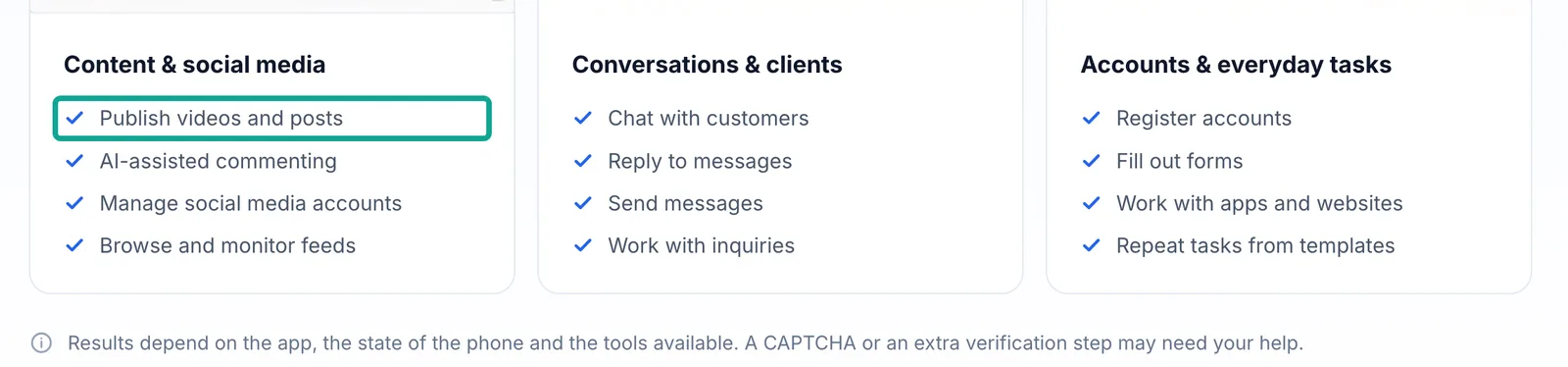
The tasks DroidDesk lists for AI on a real phone, as shown on November 15, 2026.
| Reading lane: data API | Acting lane: DroidDesk | |
|---|---|---|
| What it does | Reads public posts, profiles, comments, reviews and listings | Runs apps on a real Android phone: post, reply, fill in forms, test apps |
| Account needed | No platform login. One API key. | Your own platform account on the phone |
| How an agent connects | Remote MCP, REST or SDK | Remote MCP or the browser |
| Unit of cost | Per call: $0.000556 for each TikTok call in the test | Per rental: from $5 for 1 hour, $15 for 1 day or $60 for 1 week |
| Scale | 30 videos or 88 comments per call | One phone, one screen at a time |
| What it must not do | Read private data | Spam, engagement manipulation or fraudulent accounts, per DroidDesk's acceptable use policy |
In the test, 30 TikTok videos cost $0.000556 through the API. A rented phone is billed by time: $5 for one hour, about $0.63 per hour on the one-day plan and about $0.36 per hour on the one-week plan. So the phone fits the steps that need your own account: posting, replying and checking how a post looks in the app. It also fits the testing work that DroidDesk lists, such as a compatibility check of your own app on a real handset in another country.
A live test on a brand account: CeraVe on TikTok and Instagram
The problem
A social media manager runs a skincare brand's TikTok and Instagram accounts from a DroidDesk phone. Before the next post, the manager wants three answers. How does the brand's reach compare with other accounts that post on the same topic? Did the latest campaign work on both platforms? Which comments need a reply from the brand account? We used CeraVe as the example, because it is a large public brand account and not a personal one.
The data
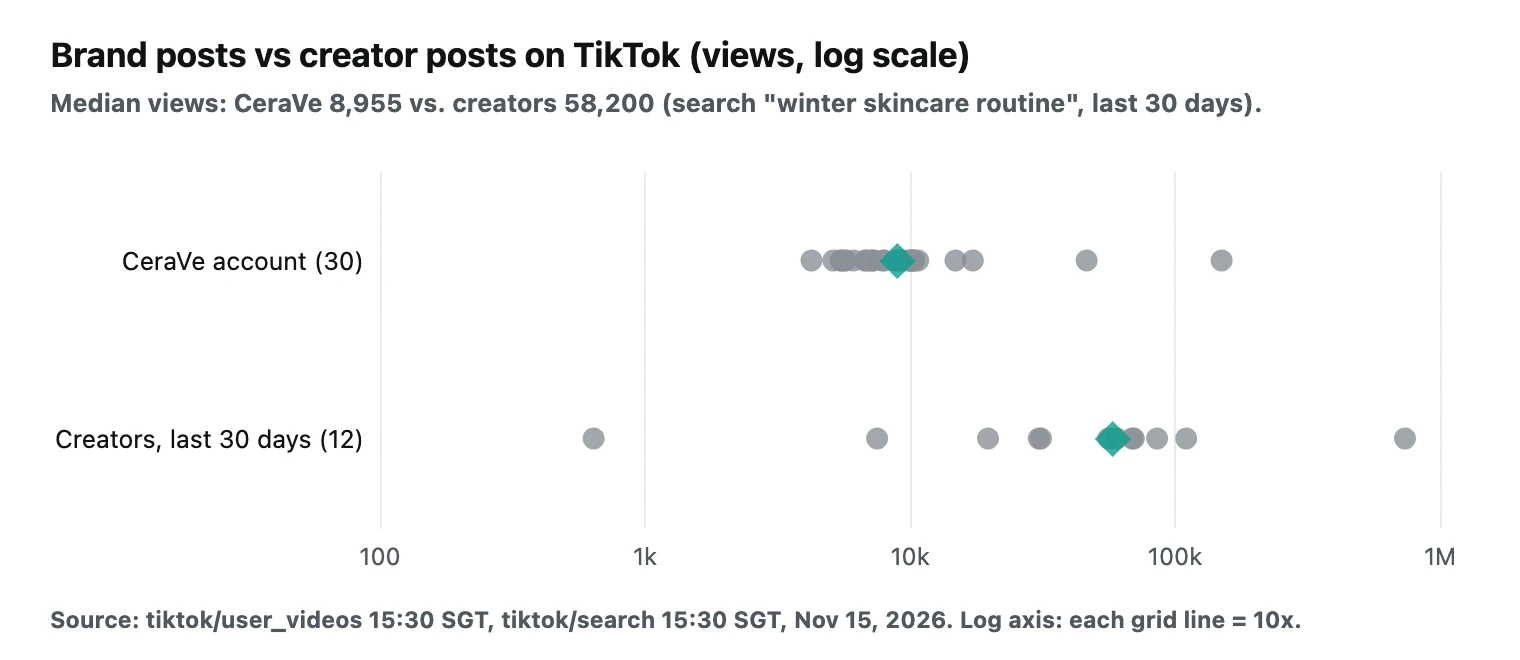
At 15:30 SGT, the TikTok profile call returned 2.1 million followers, 980 videos and 13.2 million likes, with a verified badge. The user videos call returned the 30 newest videos, posted from October 8 to November 13, 2026. Their median was 8,954.5 views. The top video, a 13-second clip about the cleanser's "milky texture", had 149,949 views, and the next had 46,409. 29 of the 30 were flagged as ads in the response, and 25 used the hashtag #DevelopedWithDerms.
Then we looked at the topic, not the brand. A TikTok search for "winter skincare routine" returned 30 videos from other accounts. 12 were from the last 30 days, and their median was 58,200 views, about 6.5 times the median of CeraVe's own videos. These 12 were also longer, with a median of 120 seconds against 28 seconds for the brand.
Across all 30 search results, the top hashtags were #winterskincare in 12 videos, #skincare in 10 and #skincareroutine in 8. 14 of the 30 were from before 2026, and 3 were flagged as ads.
| Signal | TikTok | |
|---|---|---|
| Posts read | 30 videos, Oct 8 to Nov 13 | 30 posts, Oct 2 to Nov 13 |
| Typical post | Median 8,954.5 views across all 30 | Median 1,338 likes across all 30 |
| Dune tie-in posts | 2 videos: 7,117 and 5,744 views, 596 and 271 likes | 3 posts: 11,680, 32,794 and 14,995 likes |
| Views against the median of the other posts | 0.8 and 0.6 times | No view count in the response |
| Likes against the median of the other posts | 3.0 and 1.4 times (median 197) | 9.0, 25.2 and 11.5 times (median 1,299) |
| Comments against the median of the other posts | 1.7 and 2.5 times (median 15) | 3.6, 6.3 and 4.4 times (median 51) |
| Cost of the read | $0.000556 | $0.000556 |
The campaign
CeraVe posted Dune tie-in content with the word "Arrakis" on both platforms from November 11 to 13. Three of the five posts promote tickets for Dune: Part Three, and the other two say "Coming Soon". The Instagram call returned 30 posts from October 2 to November 13, 2026, with a median of 1,338 likes. The three Arrakis posts got 11,680, 32,794 and 14,995 likes. Against the median of the other 27 posts, 1,299 likes, that is 9.0, 25.2 and 11.5 times.
Instagram returned likes and comments but no view count for these posts. So the Instagram side of this comparison uses likes only.
On TikTok, the two Arrakis videos got 7,117 and 5,744 views. That is 0.8 and 0.6 times the median of the other 28 videos, 9,120.5 views. Their likes were 596 and 271, which is 3.0 and 1.4 times the median of 197 likes. Their comments were 26 and 38, against a median of 15. So on TikTok, fewer people saw the Dune tie-in posts than usual, and the people who saw them reacted more than usual.
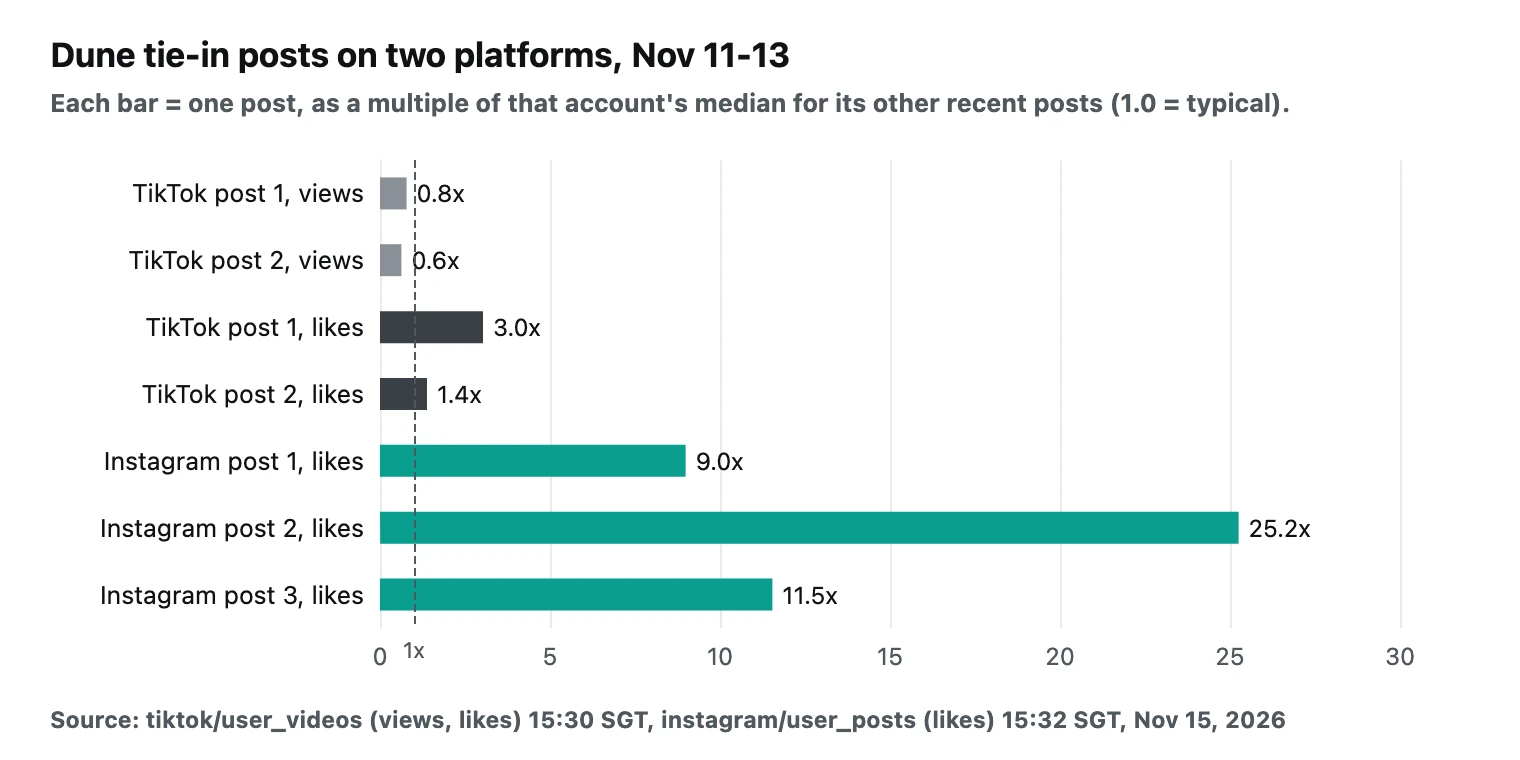
On these five posts, the Dune tie-in posts got more likes than usual on both platforms, and many more on Instagram. On TikTok they got fewer views than the account's median. One possible reason is that a larger share of the Instagram audience follows the brand and knows the film. The data cannot test that reason.
The comments
The comments call on the top video returned 88 comments, against a count of 112 on the video. 9 of the 88 were questions, and 3 asked whether a product was real or fake. 5 said that the cleanser did not foam, or not as much as in the video. Three were in Bengali, one was in Hindi or Urdu in Latin letters and one was in Russian. One more Bengali comment said that it foams for the writer. The brand had liked 5 comments, and 20 of the 88 were replies.
What it means for a DroidDesk user
The data gives the manager a short list of actions, and each one is an acting-lane task:
- Reply to the 3 real-or-fake questions with a link to the brand's store, from the brand account on the phone.
- Answer the "does not foam" comments in their own language.
- Test the next TikTok post at the length and format of the topic videos, whose median was 6.5 times higher.
- Check how each post looks in the real app before it goes live.
How an agent does both
One MCP client can connect to two remote servers at the same time. The agent can call the data API to read the 88 comments for $0.000556, and draft replies for a person to check.
Then the agent can call DroidDesk's tools to open the TikTok app on the phone and type the approved replies. DroidDesk's own page says that a CAPTCHA or a verification step may need your help, and that results depend on the app and the state of the phone. Plan a human check before each public action.
The limits
This is one brand, 30 posts per platform and one comment thread. The Arrakis comparison uses 2 TikTok videos and 3 Instagram posts, so it shows a direction, not an effect size.
TikTok's own Research API would not help this manager. Its FAQ says that creators, advertisers and commercial users are not eligible. Instagram's Business Discovery API reads only professional accounts and needs your own professional account. So for a brand team, public data through a data API is the practical way to see competitors and creators.
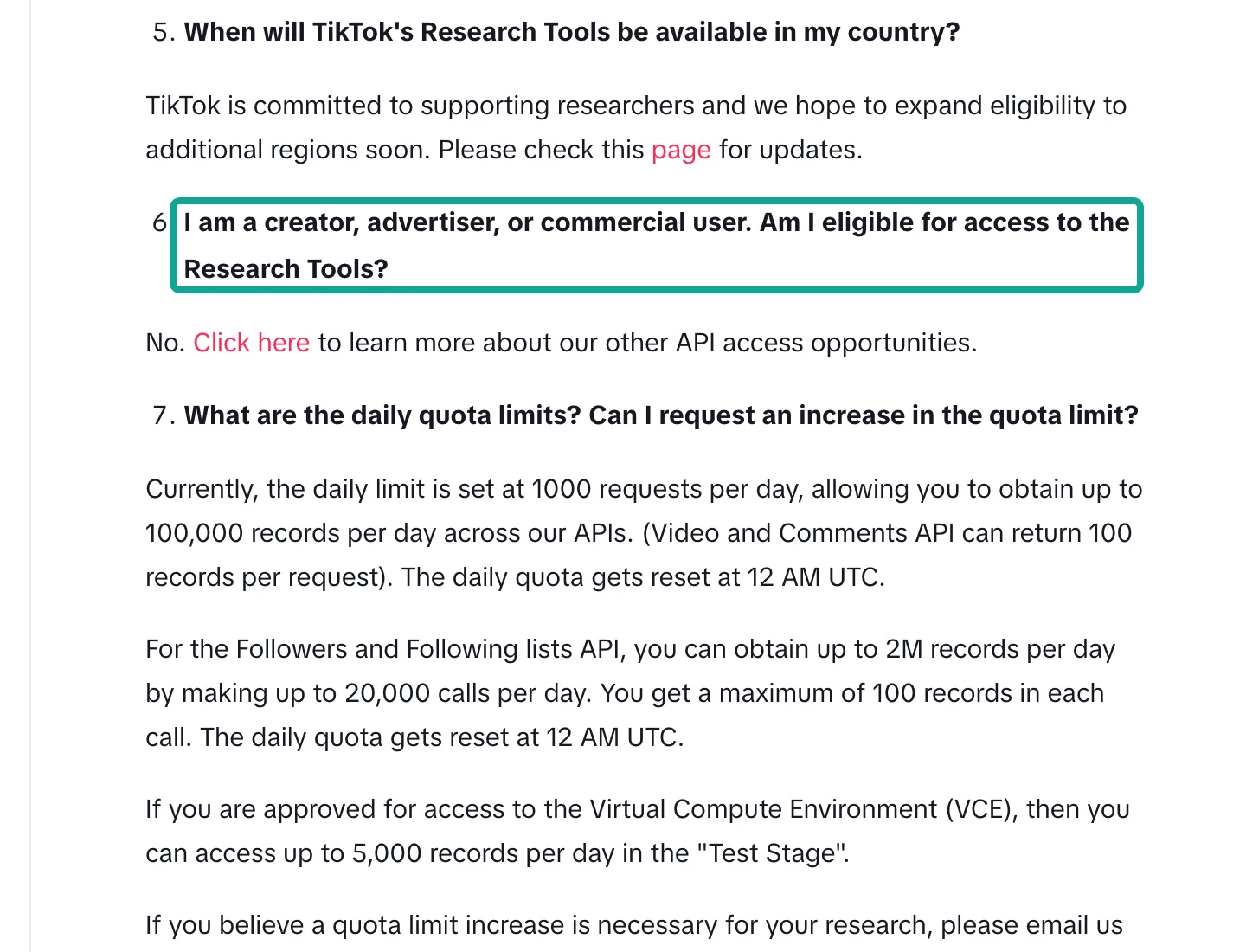
TikTok's Research API FAQ on eligibility and daily quota, read on November 15, 2026.
How to set it up
- Add the data API's MCP server to your AI client and let the agent list its tools.
- Give the agent a budget in US dollars, and tell it to read the charged amount after each call.
- Give it a retry limit too, because a failed call can ask for a retry that will not help.
- Add DroidDesk's MCP server to the same client. The AI phone automation page has the connection guide.
- Keep a human check before any post.
The agent then reads with one server and acts with the other, and you see each public action before it happens.
The same rule applies to both products. Read public data to decide what to post, then post as yourself from your own account. Do not use either product to fake reach.
Frequently asked questions
What is the best cloud phone for TikTok?
Look at three things: whether the phone is a real device, which network it uses, and what the provider allows. DroidDesk's home page says that each phone stays at its actual location on a mobile network or residential Wi-Fi. Its acceptable use policy bans spam, engagement manipulation and fraudulent accounts. It lists development, quality assurance, compatibility testing and demonstrations as permitted uses. Use a data API for research, and the phone for posting, replies and app tests on your own accounts.
Can I use the TikTok API for free?
TikTok's developer products need an approved app, and each product has its own rules. The Research API FAQ says creators, advertisers and commercial users are not eligible. Approved researchers get 1,000 requests and 100,000 records per day. For commercial use, a data API is another route. In the test in this article, each TikTok call through EveryInfra cost $0.000556.
Can one AI agent read data and control a phone at the same time?
Yes. One MCP client can connect to two remote servers at the same time. The agent reads public data through the data API's server and acts on the rented phone through DroidDesk's server. Keep a human check before each public action.
Rent a real Android phone and let your AI agent work on it over MCP.
Get started